
What the Columbia County Current Owner Record Shows
Columbia County official records and custodian guidance
| Owner of Record | Columbia County official records and custodian guidance |
|---|---|
| Vesting / Tenancy | Columbia County official records and custodian guidance |
| Mailing Address | Columbia County official records and custodian guidance |
| Situs Address | Columbia County official records and custodian guidance |
| Deed Reference | Columbia County official records and custodian guidance |
| Ownership Since | Columbia County official records and custodian guidance |
Columbia County official records and custodian guidance
Confirming the Current Owner in Columbia County
Columbia County official records and custodian guidance
- Columbia County official records and custodian guidance
- Columbia County official records and custodian guidance to confirm vesting]
- Columbia County official records and custodian guidance
- Columbia County official records and custodian guidance
- Owner of record
- Columbia County official records and custodian guidance
- Vesting
- Columbia County official records and custodian guidance
- Registered agent
- Columbia County official records and custodian guidance
Reaching a Columbia County Property Owner
Columbia County official records and custodian guidance
Lawful use. Columbia County official records and custodian guidance
Date Every Columbia County Owner-of-Record Result
A dated result is worth far more than a bare name. Every owner-of-record finding deserves a small log entry with the source, URL, capture date, SBL, municipality, exact owner text, mailing address, and latest recording reference. Add a confidence note. Dates rarely line up. Signing, recording, assessment refresh, and tax bill dates can each sit on a different day. Label the result precisely. Call it the assessment owner as of a stated date. Or call it the grantee in the latest recorded deed. Never blur the two.
The PROS access notice introduces the county parcel-card source.
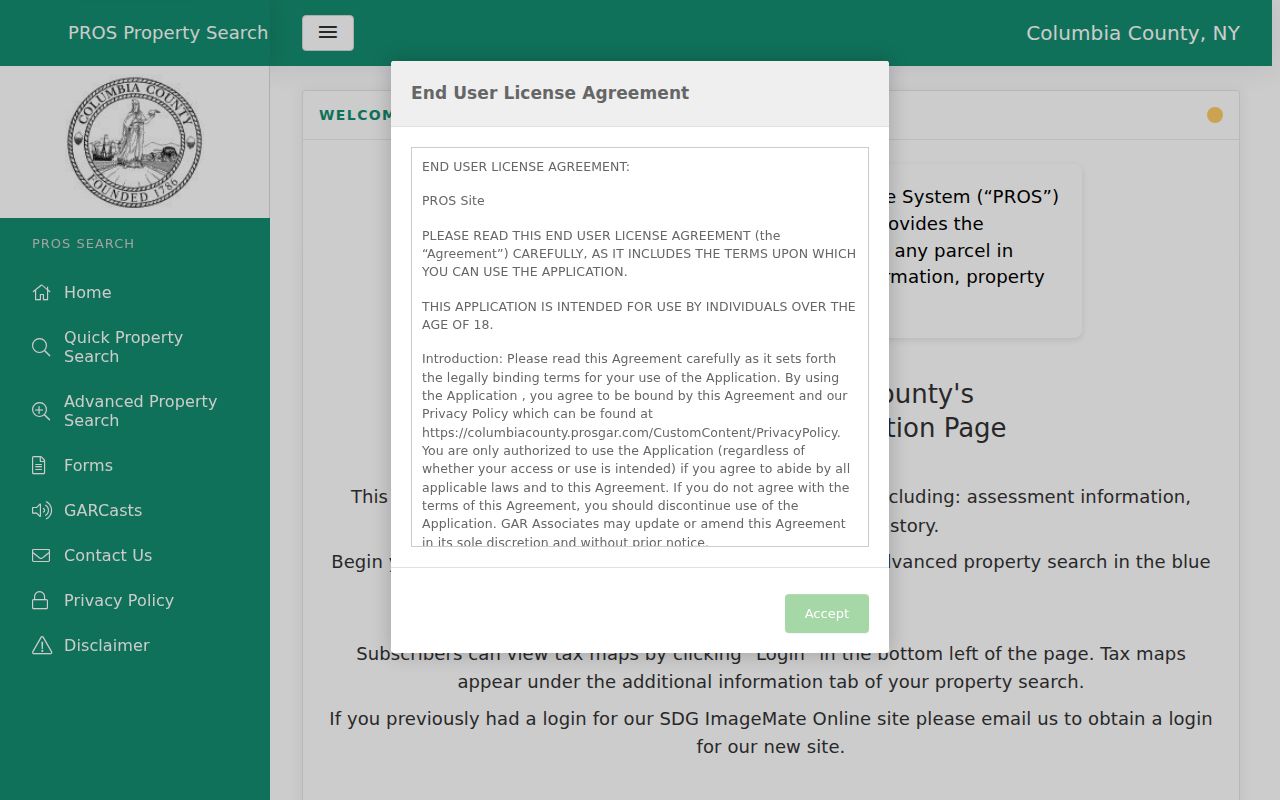
Note the assessment source and its date, then compare it against the deed index before trusting any single answer.
When Columbia County Current-Owner Sources Disagree
When sources disagree, start with dates and legal descriptions. A correction deed, a rejected filing, an estate capacity issue, a referee transfer, or a parcel split can each explain the gap. Ask the assessor about its roll. Ask the Clerk about its instrument. Neither office should be asked to interpret the other's records, and each will tell you so. A property fraud alert gives useful notice, but it neither blocks a recording nor certifies who owns the parcel.
Build a Columbia County Owner-of-Record Card
Record each result as a source card, never just a name. Copy the situs address, municipality, SBL, and owner text exactly as displayed. Also record the owner's mailing address, roll year, and assessment status. Include the land and total assessed values. Add the deed reference when one is available. Add the PROS URL and the date you pulled it. That level of detail matters. Two parcels can share an owner name. An entity can hold several Columbia County properties. The card keeps each parcel distinct from its neighbors in the property records.
Parcel identity: address, municipality, and SBL
strong placeholder
Assessment owner: exact owner-of-record text and mailing address
time_label
Time label: roll year, tentative or final status, and capture date
deed_check
Deed check: latest located grantee, recording date, and instrument reference
confidence
Confidence note: agreement, lag, conflict, or follow-up needed
The situs address and the mailing address do different jobs. An owner may receive tax mail at a post office box or an out-of-state address, and the mailing field proves nothing about who occupies the land. Hudson mailing addresses are common in the county. One does not establish that a parcel sits inside the City of Hudson. For that question, use the municipality field and the GIS boundary.
Verify a Just-Recorded Columbia County Grantee
A recent sale often creates a temporary mismatch across sources. The deed carries a signing date and a separate recording date. The assessment system refreshes on its own cycle. The tax bill reflects yet another dated process. So when PROS names one party and the newest matching deed names another, resist the urge to call one source wrong. State what each record shows and when it was dated. The gap usually closes on its own.
- Confirm the SBL and municipality on the assessment result.
- Search the named owner as grantee and grantor in SearchIQS.
- Open the newest deed that matches the legal description.
- Compare its recording date with the PROS capture date and roll year.
- Contact the responsible custodian if a correction or rejected instrument may be involved.
The deed's legal description carries the real weight here. A grantee with a common name can acquire different Columbia County land, and an address may not be indexed the way PROS formats it. Preserve the book-page or instrument number. Keep the prior-deed citation too. That way the match can be audited later against the county property records.
Current Columbia County LLC and Fiduciary Owners
The roll or deed may name a corporation or LLC. Search the New York Department of State entity database using the exact legal name. The database can show entity status, DOS ID, filing date, entity type, jurisdiction, county, and service-of-process address. Selected filing history also appears. It has limits. It does not disclose every beneficial owner. It also cannot prove the entity still holds the parcel.
Trust and estate names deserve the same care. Keep the words "trustee," "executor," or "administrator" attached to the person named. A Surrogate file may explain an appointment. A court order may authorize a transaction. But the final ownership check still lands on the recorded deed. Do not flatten the decedent, the fiduciary, and the beneficiary into one label. Each can appear at a different point in the transfer for a different reason.
Entity limit. A business filing or probate appearance explains a recorded name; it is not independent proof of parcel title or occupancy.
Monitor Columbia County Owner Filings Carefully
The County Clerk's property fraud alert accepts up to three names. When a matching name appears in a recorded document, the enrolled user gets a notice. A notice alone proves little. Unrelated people share names all the time. Retrieve the document next. Compare the legal description and parties, and call the Clerk if the instrument looks unfamiliar. Keep a monitoring file. It should hold the enrollment confirmation, each alert, the retrieved document, the parcel match, and the resolution.
The alert cannot stop a recording. It does not insure title or replace a periodic owner check. Questions about legal effect belong with an attorney or title professional.
Correcting a Columbia County Ownership Record
Send a correction to the office that keeps the problem record. The assessor can explain its owner field and how the roll updates. The Clerk can explain recording and indexing details. But it cannot rewrite a valid instrument just because another portal disagrees. A court record goes through the appropriate court clerk. FOIL obtains existing records; it is not a correction procedure.
Before contacting any office, gather the SBL, address, source date, and disputed text. Include the latest deed reference and supporting documents. Ask one focused question about that office's record. If the dispute turns on the legal ownership effect of a deed, get qualified legal or title help rather than expecting an administrative portal to resolve title.